What an AI Model Is, in Plain English: Parameters and Weights
A giant autocomplete with billions of tuning knobs
What an AI language model is, in plain English: it guesses the next word, and the parameters (weights) are its settings - billions of them. Bigger means smarter, but pricier.
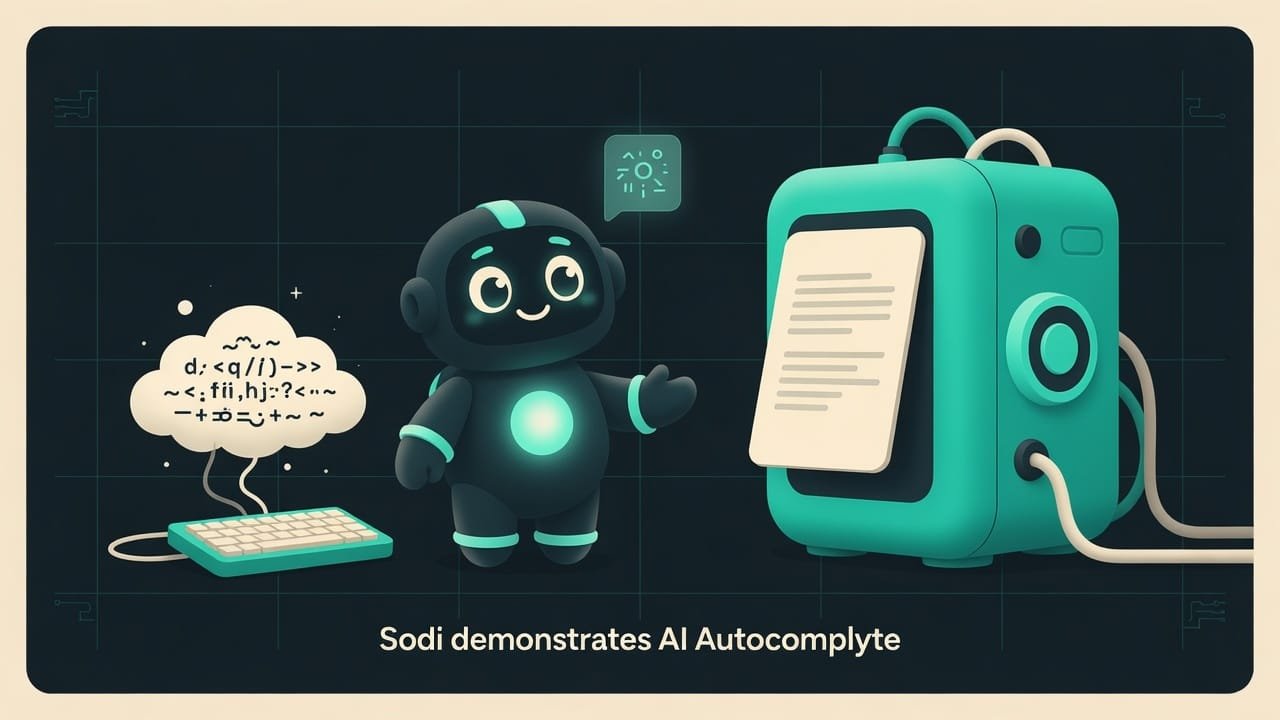
A language model in plain English: it’s autocomplete
Remember the suggestions on your phone keyboard? You type “thanks for your” - and it’s already shoving “help” at you. Well, a language model is exactly that same autocomplete. Just blown up to monstrous size and trained on a mountain of text the size of half the internet.
Its job is almost insultingly simple: guess which chunk of text comes next. You give it a beginning - it builds out the most likely continuation. Then another chunk. And another. And another. And out of that humble “guess the rest” grow answers to questions, code, and birthday poems for your mother-in-law.
Why understand how a neural network works
You can use AI completely blind. But then every quirk it has will feel like either magic or a malfunction. Grasp the basics, though, and a lot of it clicks into place.
- You’ll stop demanding the impossible. The model doesn’t “look things up in a reference book” - it builds out the likely continuation. That’s where the made-up stuff comes from.
- You’ll understand why one model is smarter than another, and why being smart costs extra.
- You’ll learn to read the names. 7B, 70B, 405B A parameter (also called a weight) is a single number inside the model, a tiny tuning knob. The whole model is made of billions of these knobs; everything it has learned is encoded in them. will stop being meaningless noise.
- You’ll make smarter choices later in the course: where a lightweight model is enough, and where you can’t get by without a heavy one.
Nine out of ten disappointments with AI happen when people expect miracles from an “all-knowing mind,” when in reality the thing is just very cleverly guessing the next chunk of text. Dial down the magic - and you’ll get steady results.
How an AI model works: tokens, weights, and training
Let’s break it down, no formulas. There are only three ideas, and all of them are simple.
What a token is: the model doesn’t work with words
Inside, the model sees text not as words but as tokens A token is a chunk of text the model operates on. Sometimes it's a whole word, sometimes part of a word, or even a single character. The model predicts the next token, not the whole word. - pieces of words. A short word might be a single token. A long, rare one shatters into several. For you that’s a minor detail, but keep it in mind: when people say “the model predicts a word,” technically it’s predicting the next token.
What model parameters and weights are
Inside the model is a giant grid of numbers. Each of those numbers is a parameter, a.k.a. a weight. Picture a sound engineer’s mixing board, covered all over with volume knobs. Except a regular board has a couple dozen knobs. A model has billions.
Each knob nudges, just a little, which token the model considers likely next. On its own, a single knob means almost nothing. But all together, billions of knobs encode grammar, facts, style, logic - everything the model has ever learned.
How a neural network learns: automatic knob-tuning
Nobody sets billions of knobs by hand - that’s physically impossible. They do it differently. They dump a mountain of text on the model, hide the next chunk, and say: guess. Guessed wrong - a special algorithm nudges the knobs a tiny bit toward the right answer. And so on, countless times over.
Gradually the knobs settle into a configuration where the model guesses more and more accurately. That’s what “training” is. No human-style understanding - just a very long and very expensive fitting of numbers to one task: guess what comes next.

More parameters means smarter, but not for free
Rough rule of thumb: the more parameters, the more capable the model. More knobs means more nuance it catches: a finer feel for context, better reasoning, fewer slip-ups in its story.
But you pay for it. Every chunk of an answer is a run through all those billions of numbers at once. The more there are, the pricier and slower it gets. Smarts don’t come free.
- Smarter - reasons better, holds a long context, understands your request more subtly.
- Broader knowledge - more facts and styles fit into billions of knobs.
- Steadier on hard tasks where a lightweight model simply falls apart.
- Pricier - more computation per answer, a higher cost per request.
- Slower - the answer takes longer to print out, especially a long one.
- Hungrier - you can't run a heavy model on a regular laptop, you need powerful hardware.
How to read a model’s name: what 7B and 70B mean
You go to pick a model - and the name has a number with a B sticking out: 7B, 13B, 70B, 405B. The decoding is dead simple.
B stands for billion. The number before the B is the parameter count in billions.
7B  - about seven billion parameters. Light and quick, modest on brains. Often runs even locally.
70B - on the order of seventy billion. Noticeably smarter, but needs a serious graphics card or the cloud.
405B and up - the heavyweights. Very capable, but expensive and usually living only in the cloud.
Bottom line: the number is a rough “brain size.” Bigger number means smarter and pricier. Match it to the task.
Common beginner mistakes when working with AI
- Thinking the model “knows” facts like a database. It doesn’t pull an answer out of storage - it builds out the likely continuation. That’s why it can make things up with a straight face. That’s not a bug, it’s its nature.
- Confusing parameters with memory or internet speed. Parameters are the size of the model’s “brain” itself. Not how much RAM you have or what your bandwidth is.
- Assuming “more parameters” is always better. For a simple task that’s wasted money and wasted waiting. Size matches the task, full stop.
- Believing there’s thinking or consciousness inside. Inside there’s number multiplication and statistics on an industrial scale. Impressive? Yes. But it’s not a mind.
- Expecting a word-for-word identical answer to the same question. The model picks the next token with a bit of randomness, so answers drift a little. That’s normal and adjustable.
TL;DR - если коротко
- A language model is a giant autocomplete. Its entire job: guess the next chunk of text. Everything else grows out of that.
- Parameters (a.k.a. weights) are the model's internal knobs. There are billions of them, and everything it ever learned is baked into them.
- Training is the automatic tuning of those knobs until the guessing gets good. Nobody turns them by hand.
- More parameters usually means smarter. But also pricier and slower. Always a trade-off.
- The number with a B in the name (7B, 70B) is the parameter count in billions. B stands for billion.
- There is no consciousness inside. It is statistics and number-crunching on an industrial scale.