Where to Find Design Inspiration and How to Steal Like an Artist
Where to look at good design and how to steal smart, not photocopy
Where to find design inspiration: Dribbble and Behance galleries, real products in Mobbin, design systems like Apple HIG and Material. How to steal like an artist and build your own style.
What a trained eye actually means
There’s a comforting myth: the designer sits around waiting for the muse, and then - bam! - an idea drops from the sky. Pretty story. Just not true. In reality it’s far more down to earth. Taste and strong solutions grow out of one thing - a trained eye A trained eye is the body of quality examples you've seen and thought about. The more good work in front of you, the easier it is to tell good from bad and build your own. .
Picture a chef who has never tasted anyone else’s cooking. They’re guessing. Now picture one who has eaten their way through a hundred restaurants - they feel the combinations and assemble a dish from proven moves. Design works the same way. Inspiration isn’t a gift, it’s an archive of good work living in your head.
And here’s where the legendary line from artist Austin Kleon shows up: “Steal like an artist.” Sounds bold? The meaning is honest. Nothing comes from nowhere - everything new is built out of something old. The only question is how you steal, so what comes out is your own and not a tracing.

Why a designer needs a trained eye and inspiration
You can sit down and squeeze design straight out of your head. You’ll get one of three things: something scary, something that looks like everyone else’s, or an hour of staring at an empty screen. Or you can spend twenty minutes seeing how strong people already solved the same problem - and then do it better and faster. Which do you pick?
- You’ll stop staring at a blank screen - there’s always something to start from.
- You’ll learn to tell good from trendy - and that’s exactly what taste is.
- You’ll steal on purpose instead of accidentally repeating someone else’s work and ending up embarrassed.
- You’ll build your own recognizable style faster: it’s born from a blend of your favorite sources.
Nine out of ten “I have no imagination” really mean “I haven’t seen much.” Imagination isn’t innate - it’s trained through your eyes. The more good work you see, the more you can do.
Where to look at good design: three types of sources
Sources come in three types, and you need all three. They answer different questions. One tells you “here’s what beautiful can look like,” the second “here’s how the people who actually ship it do it,” the third “here’s the proper, by-the-book way.”
Design galleries: Dribbble, Behance, Awwwards
These are showcases where people post their work. This is where you catch visual taste: color, type, composition, mood.
- Dribbble Dribbble is a platform where designers post small visual pieces and interface shots. Great for taste: palettes, fonts, style. The downside - a lot of it is pretty but unworkable. - short, pretty shots. Perfect for palettes and mood. But be careful: some of it is image-for-image’s-sake, and you can’t pull it off in a real product.
- Behance (by Adobe) - here you get whole projects with write-ups, not just a single shot: how they got to the solution and why. Better for understanding the logic, not only the picture.
- Awwwards, Godly, Lapa Ninja, Land-book - collections of strong sites and landing pages. You go here for the wow factor and for how “expensive” pages are put together.
Real products: Mobbin and live apps
The most underrated source. A pretty Dribbble shot can be pure fantasy. But a live app used by millions is a set of solutions that have already been tested by money and people. Huge difference.
- Mobbin Mobbin is a library of real screens from live apps: onboarding, checkout, settings. It shows you not a dream-picture but how things are actually done in products that genuinely work. - a library of real screens from live apps: whole flows, from sign-up to checkout.
- The apps and sites you already use. Open your bank, your delivery app, your favorite service - and watch how they solve the thing that’s bugging you. It’s a free masterclass every single day, right in your pocket.
Design systems: Apple HIG and Material Design
These are the rule books from big companies: which spacings, which sizes, how buttons behave. You take them not for the looks but for solid ground under your feet.
- Apple HIG Apple Human Interface Guidelines (HIG) is Apple's official guide on how interfaces should look and behave on their devices. The benchmark for precision and restraint. and Apple’s product line - the benchmark for restraint and attention to detail. Watch how they do NOT overload the screen.
- Material Design (Google) - a detailed system with ready-made rules for spacing, color, and motion.
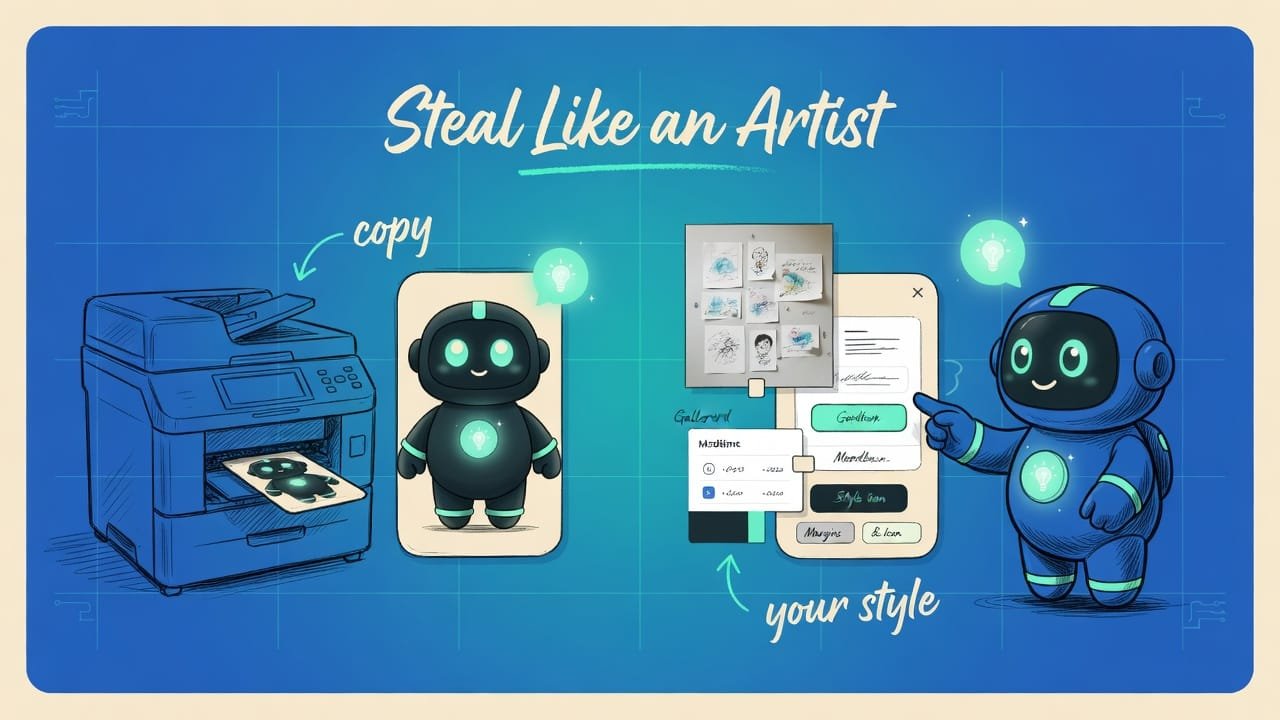
How to steal like an artist, not like a photocopier
Here’s the whole thing. There are two ways to “get inspired by someone else’s work,” and they give opposite results. One makes you an artist. The other - a photocopier.
- You take the idea and the principle: “the whitespace here is doing the work of calm.”
- You steal from many at once - mixing ten sources into one.
- You adapt it to your own task, audience, and content.
- You rebuild it with your own hands - and add yourself along the way.
- You take the pixels one-to-one: same colors, same font, same layout.
- You steal from one person - that's not inspiration anymore, it's a tracing.
- You slap someone else's work in as-is, without asking if it even fits you.
- You add nothing - what comes out is a pale copy of the original.
The main rule is simple: one source is plagiarism, ten sources is your style. When you steal from one person, it’s instantly obvious who. But when you blend one person’s head, another’s hand, and a third’s color - out comes something that didn’t exist before. That’s what creativity is. No magic.
Example: building a login screen from blank page to your own solution
Say you need to make a login screen for an app, and your head is empty. Sound familiar? Don’t invent from scratch. Steal smart - just follow these steps.
- State the task in one sentence: a login screen, calm, for a finance app.
- Go to real products (Mobbin) and galleries (Dribbble, Behance). Collect not one but 8-10 examples of logins.
- For each one, ask yourself: what do I like here, and WHY. Write it out in words - whitespace, a big button, a soft background.
- Gather those reasons into a list of principles. That’s your recipe, not someone else’s layout.
- Close every tab with references and build your own screen from the list of principles, with your own hands.
- Compare it against the sources. If exactly one of them is recognizable - you copied. Mix harder.
Common mistakes when hunting for inspiration
- Waiting for the muse. Inspiration doesn’t come to those who wait - it comes to those who look. Open a gallery instead of sitting over a blank screen.
- Copying one person head-on. A single source is always recognizable. Take from many and mix - that’s how your own thing is born.
- Dragging a Dribbble shot into a real product. A pretty shot is often unworkable: it has no real data, no long text, no error states. Check it against live apps.
- Stealing the look, not the reason. You copied the button color but never understood why - now you’ve got an alien detail. Steal the principle, not the pixel.
- Looking only at what’s trendy. A trend will be stale in a year. Learn to tell the polished (Apple, design systems) from the merely hyped.
- Collecting nothing. Without your own reference folder, you start from zero every time. Collect taste in advance.
TL;DR - если коротко
- Inspiration isn't a muse falling from the sky - it's a trained eye. The more good stuff you've seen, the better you make.
- Look in three places: galleries for taste, real products for proven solutions, design systems for the fundamentals.
- “Steal like an artist”: take the idea and the principle, not the pixels. A one-to-one copy is a fake.
- Steal from ten, not from one: one source is plagiarism, ten is your style.
- Make it yours: take the what and the why, throw out the how, and rebuild it by hand.
- Start your own junk-drawer folder of references. Without a collection, there's nothing to draw on.