AI for business and personal growth: where the skill gap creates an advantage
While some argue about AI, others use it as a lever. Let's pin down exactly where that lever sits
While some argue about AI, others use it as a lever. Specific areas of application with practical effect.
One tool, two results
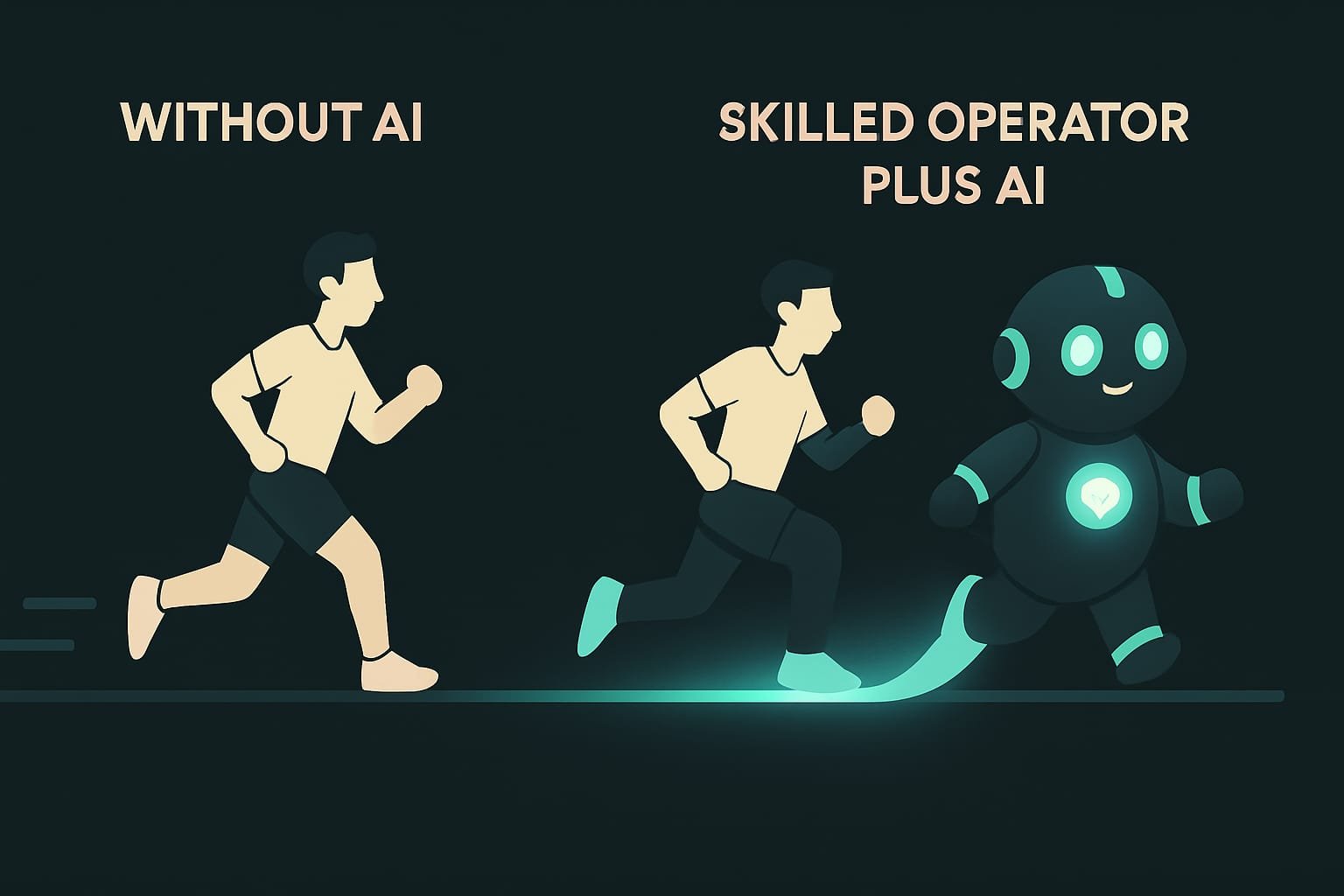
Let’s lock in the fact that the entire practical part builds on. Access to AI is identical for everyone today: the same models, the same subscriptions for a nominal twenty dollars, the same documentation. And the results are radically different. One marketer with AI gets through a week’s worth of work in a day, with no dip in quality. Their colleague with the same access generates twenty identical posts and wonders why the reach died.
The technology is the same. The difference is the operator: their habit of loading in context, their taste, their review process. In other words, everything we covered in the first two chapters.
From this follows a conclusion that matters to anyone building a business or a career: the operator skill gap is a competitive advantage currently lying out in the open. You don’t have to buy it, it needs no license, and it has no entry barrier except practice. That happens rarely in the history of technology and never lasts long: in a few years, working with AI will be table stakes, like knowing how to use email. The advantage goes to those who build the skill while the gap is still wide.
The gap is already visible to the naked eye if you know where to look. In job listings: “confident use of AI tools” has moved from the “nice to have” section into the requirements. Among contractors: some studios cut their timelines in half at the same quality, others raised prices without changing a thing. In hiring: the candidate who can show their AI workflow at the interview beats the candidate with the same credentials but without one.
And since it’s a skill, the gap closes with practice. Not with talent, not with budget, not with a “technical mind”. With practice.
Five leverage points
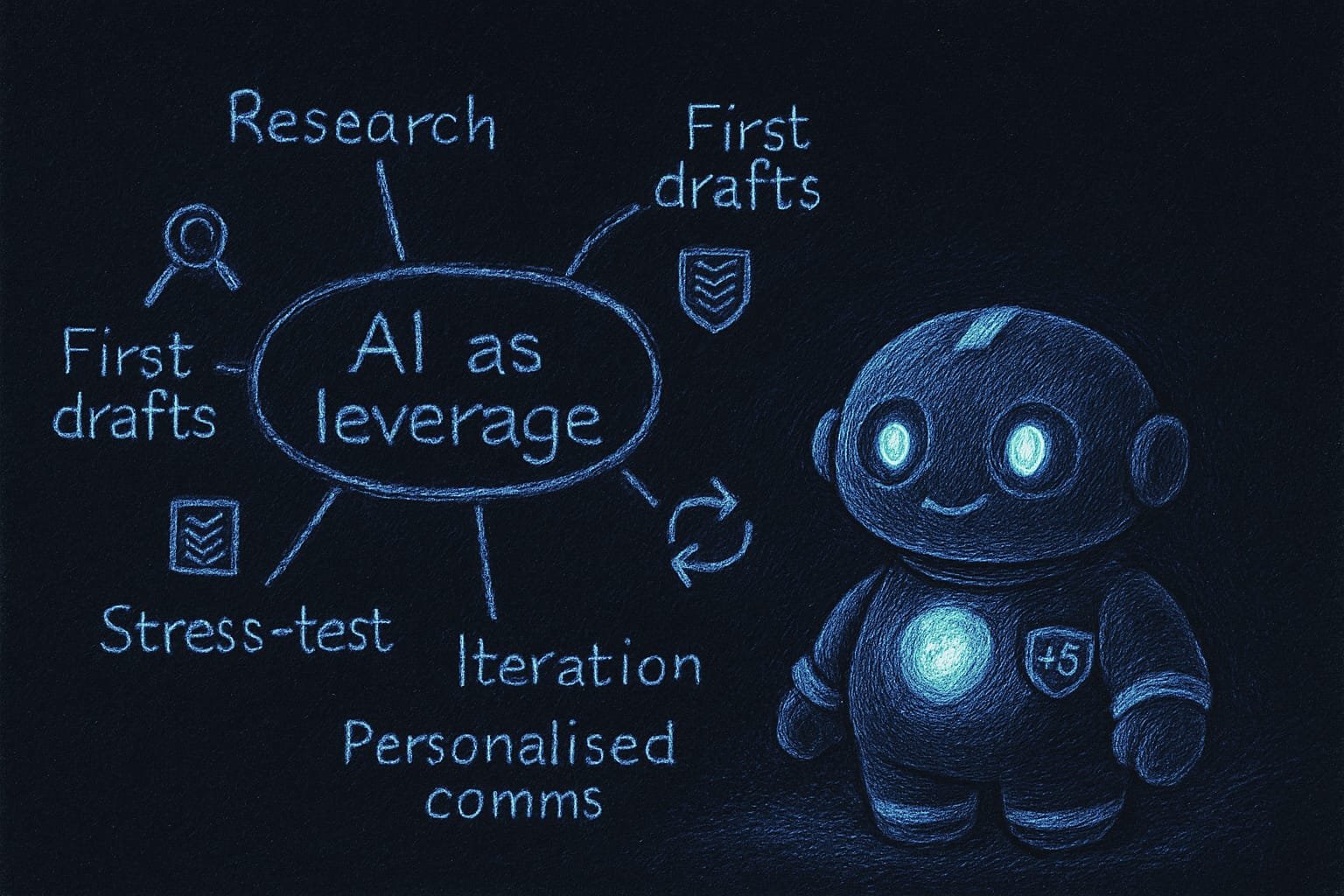
The word “lever” isn’t here for decoration. A lever is when the same effort produces a multiple of the result. Here are five areas where AI works exactly like that - with the mechanism spelled out for each.
1. Research and synthesis. Getting your head around a new market, condensing a dozen reports into a digest, comparing competitors’ offers, finding contradictions in the data. The mechanism: AI compresses the “plow through and structure” stage from days to hours, and you spend the freed-up time on what the machine won’t do - conclusions and decisions. Important: every fact from such research gets verified - the rule from the review lesson still applies.
2. First drafts. An email, a sales proposal, a presentation outline, a job description. The mechanism: it removes the blank-page block - psychologically the most expensive stage of any work. Editing a draft is several times faster and easier than writing from scratch; AI lets you always be in the editor’s seat instead of the author’s, staring at a blank page.
3. Stress-testing ideas. Before you sink money and months into an idea, ask the model to play devil’s advocate: “here’s my launch plan - name ten reasons it will fail”, “you’re a nitpicky investor - tear apart my unit economics”, “you’re a customer who finds it too expensive - object”. The mechanism: the model instantly generates the objections you’d have arrived at a month after launch - when they’d have become expensive. A cheap rehearsal of expensive mistakes.
4. Faster product iterations. A landing page, a prototype, offer variants, onboarding copy, A/B hypotheses. The mechanism: the “idea - test” cycle compresses from weeks to days. Over the long run, the winner isn’t the one who guessed right the first time - there are no such people - but the one who managed to test more hypotheses with the same time and money.
5. Personalized communications. Not one email blast for everyone, but a version for each segment: one thing for new clients, another for dormant ones, a third for the big accounts. Same with cold emails: a personal angle based on the company’s public data instead of a template. The mechanism: personalization used to be bottlenecked by man-hours and therefore never got done; now that constraint is gone - and audiences respond noticeably better, because an email “for me” always beats an email “for everyone”.
Notice the common denominator: in all five points, AI speeds up the iteration of thinking - the cycle from “had a thought” to “tested it and drew a conclusion”. That’s the main effect; everything else is special cases of it. And notice what isn’t on the list: “AI will invent your strategy”, “AI will find your niche”, “AI will build your business”. Decisions and responsibility stay with you - the lever merely multiplies the number of attempts you can fit in before the end of the month.
An amplifier, not a replacement
Now the critical caveat, without which the five leverage points don’t help - they hurt.
AI amplifies what’s already there. A marketer who understands the audience and the unit economics does marketing better and faster with AI: the model shapes and scales their thinking. A person without that understanding gets the opposite effect: the model shapes and scales their emptiness. They produce slop - just at assembly-line speed now.
So the lever formula is honest: result = competence × iteration speed. AI dramatically increases the second factor and in no way replaces the first. If the first factor is zero, multiply by any speed you like - you get zero. The good news: competence also builds faster with AI - more on that in a moment.
What a week with leverage looks like
So the five points don’t stay theoretical, here’s the working week of a small studio owner (online school, agency, manufacturing - substitute your own):
Monday. Before a meeting with a potential client from a new industry - 40 minutes of research with AI: industry specifics, typical pain points, vocabulary. At the meeting, he speaks the client’s language. This kind of prep used to take a day - and often didn’t happen at all.
Tuesday. Three sales proposals. Drafts from a saved prompt from past deals, 10 minutes each; an hour for personalizing them to the specific clients: their numbers, their situation. The outcome: three personalized proposals in half a day instead of one templated one.
Thursday. An idea for a new pricing tier. Before discussing it with the team - a stress test: “name 10 reasons clients won’t buy” and “calculate at what churn rate the tier goes underwater”. Two weak spots found before launch, not two months after.
Friday. An email to the client base: not one for everyone, but three versions - new, active, and dormant. Open rates among the “dormant” climb, because for the first time the email is actually about them.
Nothing heroic: the same tasks as always. Just each one with a lever - and put together, the week fits what used to take a month.
What “I’ll wait until it settles” actually costs
About the skeptics - no moralizing, pure arithmetic.
The position “the tech is raw, I’ll wait a year or two until things settle” sounds sensible and prudent. The problem is that it has a price, and the price is hidden. The operator’s skill - context, taste, iterations, review - doesn’t appear when you buy a subscription. It accumulates over months of practice: through failed prompts, through discarded drafts, through gradually tuning the process to your own tasks.
Which means: when the skeptic decides it’s “time”, they’ll be starting from zero - and by that point their competitor will be a year or eighteen months of practice ahead. And that gap doesn’t close with money: you can buy access, but you can’t buy a road-tested process or a trained taste. Every month of waiting is months of someone else’s head start.
The argument “the models will change anyway, why learn now” fails for a simple reason: interfaces change, but the operator’s skill - context on the way in, quality criteria, targeted iterations - transfers between models in its entirety. Whoever learned on today’s tools will master tomorrow’s in an evening. Whoever never started will be playing catch-up there too.
That said, skepticism itself is a healthy trait; this whole course is, at its core, skepticism toward mindless AI use. The difference is one word: skepticism with practice makes you a demanding operator; skepticism instead of practice makes you a spectator of other people’s growth. Test the technology hands-on, not through opinions from your feed.
TL;DR - если коротко
- The operator skill gap is an open competitive advantage: same technology for everyone, different results.
- AI amplifies existing competence: the expert gets leverage, the amateur gets slop faster.
- The main effect is the speed of thought iteration: more tested hypotheses in the same amount of time.
- Five leverage points: research, first drafts, stress-testing ideas, product iterations, personalization.
- Skepticism without practice is an expensive position: every month of waiting is months of someone else's skill-building.