A system for working with AI: how to assemble it all into a workflow
The principles and habits that turn working with AI from a lottery into a reproducible result
The course's final lesson: principles and concrete habits that turn working with AI from a lottery into a reproducible result.
System versus luck
By now you have all the parts: you can see slop in thirty seconds, you know the five scenarios that produce it, you can build a prompt, iterate, and check the result. One last step remains - assembling the parts into a setup that works every day, not just when you’re in the mood.
Why this matters is visible in the difference between two states. The first: “yesterday AI gave me a great text, today it’s nonsense - I have no idea what it depends on.” That’s a lottery: the result belongs to chance, and you can’t build a content plan or a business process on it. The second: “I know my process; a typical task takes half an hour, and the result reliably passes my checklist.” That’s a system: the result belongs to you.
The difference between them isn’t ability and isn’t “magic prompts”. It’s a handful of habits drilled until they’re automatic. That’s exactly what separates a professional from an amateur in any craft: the amateur occasionally produces a masterpiece, the professional delivers stable quality on deadline. The second one you can work with. The second one you can make money with.
And notice the word “habits” - not “knowledge”. Everything you’ve read in this course will stop working in two weeks if it stays knowledge: under a deadline, your hand will reach for the old scenario all by itself - “one-line prompt - copy - publish”. A system wins not when you agree with it, but when it’s built into how you work by default.
The three principles of the system
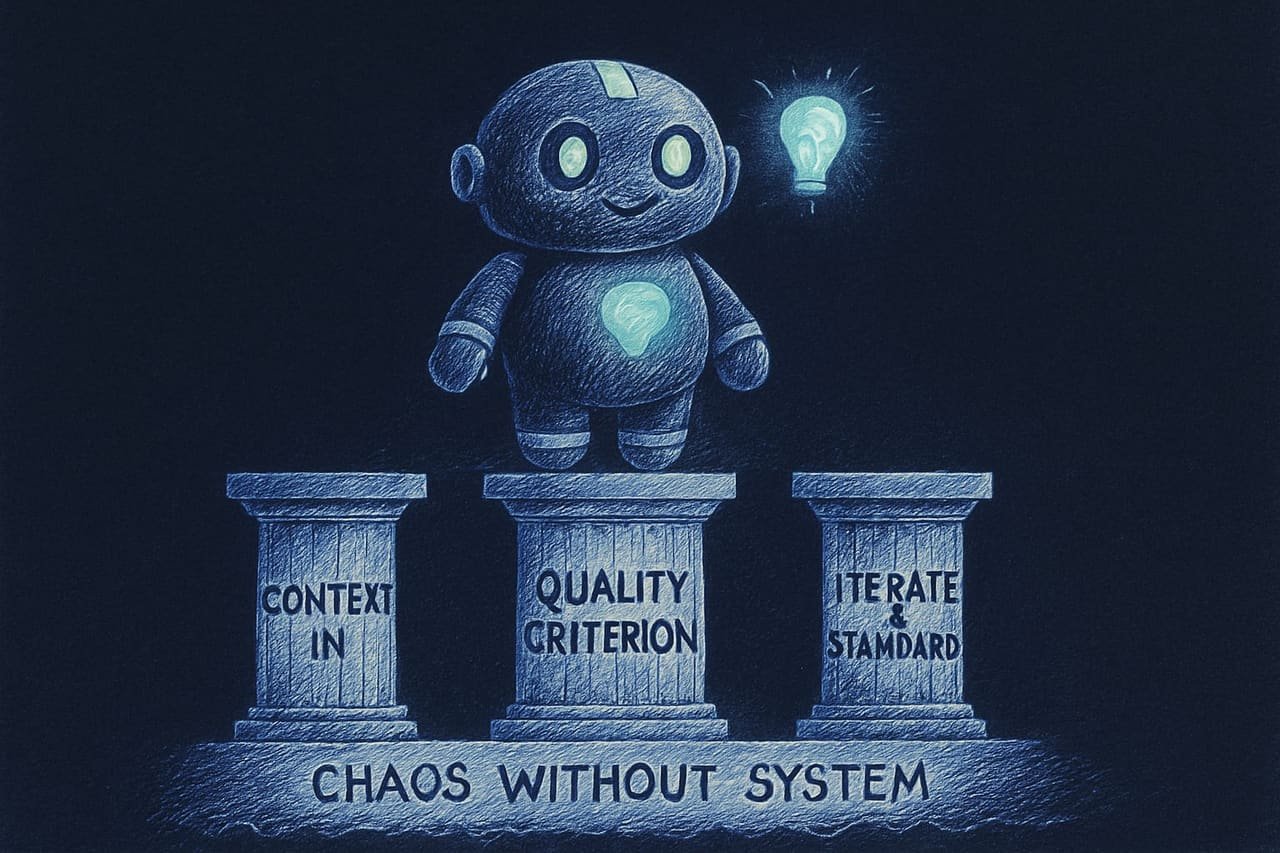
The entire system rests on three principles. They’re short, and each one closes off its own cluster of mistakes from lesson three.
Principle 1: context on the way in - always. Two minutes before the request: who’s the audience, what facts and numbers do I have, what should happen to the reader, what’s the tone. This cures “no context”, and half-cures “greed for volume”: once you’ve invested in the input, you can’t bring yourself to order twenty posts in bulk. You’ll know the habit has taken when a context-free request feels physically uncomfortable.
Principle 2: the quality criterion - in advance. Before starting work, answer for yourself: what does “good enough” mean for this task? For a post - it passed the five-question checklist and has an anchor detail. For a sales proposal - add a numbers check and a read-aloud pass. For a contract or a white paper - add an outside pair of eyes. A criterion defined in advance protects you from both sides at once: from slop - because “the first coherent answer” no longer equals “done”, and from perfectionism - because “enough” is decided by the list, not by how you feel. A handy format is a three-column table in your notes: task type, done criterion, how many iterations it usually takes. Five rows cover ninety percent of your regular work.
Principle 3: iterate to the standard, accept by the criterion. Done is when the result has passed your criterion from principle 2. Not when you’re “tired of fiddling”, not when it “seems fine”, not when the deadline is crushing you. Fatigue is the worst editor there is: it always votes for “good enough as is”. A standard fixed in advance doesn’t get tired.
Check it for yourself: the three principles are, point for point, the answers to three questions from the five scenarios of lesson three. What did I put in? How will I recognize good? When do I stop? The system is precisely the operator scenarios turned inside out - from mistakes into habits.
The prompt library: an asset that appreciates
Systematic work has a side effect that quickly becomes the main one: everything you do accumulates.
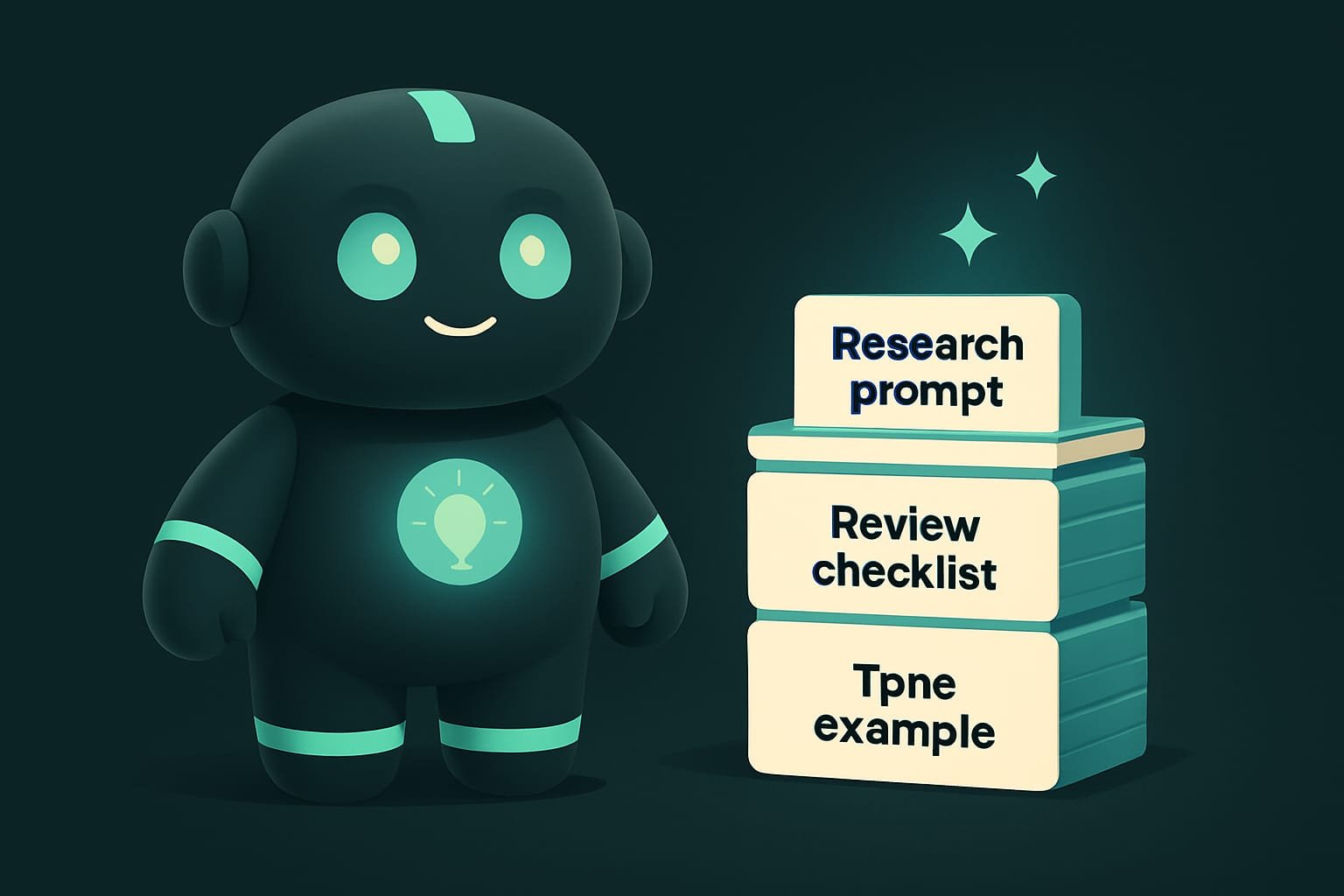
Set up a storage spot - notes, a document, a folder, doesn’t matter - and stack three types of things in it:
- Working prompts. A prompt that produced a strong result gets saved whole: role, context, constraints. Next time, a similar task starts not from zero but from a proven template you drop new facts into.
- Benchmark examples. Your own and other people’s texts whose tone and level you consider the bar. This is material for the fifth prompt element - the example: instead of a paragraph of explanations about voice, you just attach a sample.
- Your own checklists and criteria. The review checklist adapted to your tasks; “good enough” criteria by task type; the list of cliches you catch yourself using most often.
The economics of this asset are beautiful: every next task costs less than the one before. Three months in, you have templates for all your regular tasks, and typical work starts at 80 percent done. A year in, it’s a full-fledged playbook: you can hand it to an employee, and they’ll start delivering your level of quality in weeks instead of months. Not one hour invested in the library goes to waste - unlike one-off “genius prompts” that are forgotten by Friday.
The crown jewel of the library is a personal system prompt: a block of context about you that gets dropped in at the start of any working session.
Who I am: [role and field. Example: co-founder of a kids’ party studio in Austin, I run the marketing myself].
My product: [what you sell, to whom, what makes it different. Be specific, no “unique solutions”].
My audience: [who these people are, what they know, what they’re afraid of, what language they speak].
My data: [3-7 key numbers and facts usable in texts: revenue, timelines, case studies, reviews].
My tone: [2-3 lines. Example: conversational, warm, no exclamation marks and no corporate-speak; friendly and informal; humor - light, no clowning].
My no-go list: [what never to do: cliches from the stop list, promises without facts, invented numbers].
How we work: plan first - text only after my OK; the first answer counts as a draft; make edits point by point, without rewriting the parts that work.
A note on the structure: the first four blocks are your “context on the way in”, saved once and for all (principle 1 on autopilot). The tone and the no-go list save you an iteration on every task. The last block sets up the process - plan, draft, point edits - without reminders.
Filling it in takes half an hour, and it may be the best-paying half hour in this entire course: the system prompt works on every task, every day, with no extra effort. Reread and update it once a month - new numbers came in, the product emphasis shifted, the cliche stop list grew.
How to install it: one habit per week
Trying to install everything at once is the classic way to install nothing. The working scheme is a month, one habit per week:
Week 1: context on the way in. The only rule: not a single request without two minutes of context - audience, facts, goal, tone. Change nothing else. By the end of the week, short requests will start to feel uncomfortable - and that’s the sign the habit has taken.
Week 2: the criterion and the checklist. Before each task - one sentence: what “good enough” means for this result. After each one - the five-question review checklist. At first it will feel slow; by the end of the week, the check takes two minutes.
Week 3: targeted iterations. Ban yourself from the words “redo it” and “make it better”. Every edit names a spot, a problem, a direction. Watch the counter: the norm is two to four iterations to the standard.
Week 4: the library. Set up your storage and put the first three cards in it: the week’s best prompt, one benchmark example, your checklist. Then keep adding as you work - a card or two a week.
A month later you don’t have “knowledge about working with AI” - you have a working system. From there it improves on its own, with every task.
Where all this leads
One final calibration. The system’s goal is not “AI works instead of me”. The goal is “I think faster and sharper because I have AI”. The difference isn’t cosmetic: in the first formula you remove yourself from the process - and get the average with no stake and no position, that is, slop. In the second, you remain the owner of the thinking: your context, your position, your standard, while the model speeds up the “thought - tested - improved” cycles severalfold.
All the strong applications from the last lesson - research, drafts, stress tests, iterations, personalization - are built on the second formula. All the slop examples from the first lesson - on the first. Choosing the formula is the only genuinely strategic decision in the entire AI topic. The rest, as you now know, is craft and habits.
There’s a simple daily test that shows which formula you’re living in. In the evening, ask yourself: did I make decisions faster and sharper today because AI cleared away the grunt work - or would I be unable to explain why the text I published says what it says? The first is leverage. The second is slop, even if everything looks respectable on the surface.
TL;DR - если коротко
- Reproducible quality is a system of habits, not luck with a generation.
- The three pillars: context on the way in, a quality criterion, iteration to a standard.
- A personal library of prompts and benchmarks is a compounding asset: every next task costs less than the one before.
- The system's goal is “I thought faster and sharper with AI”, not “AI did it for me”.
- The course in one line: slop is an operator error; the operator is fixed by practice; the skill gap is an open advantage.