Why smart people make slop: the five operator scenarios
Slop isn't the product of bad AI. It's the product of specific, fixable human mistakes
Slop isn't the product of bad AI. It's the product of specific operator mistakes. We break down all five scenarios.
A weighted average of the internet
Let’s start with the mechanics - without them, nothing else will make sense.
A language model is trained on a gigantic mass of text. When you give it a request with no specifics - “write an article about marketing” - it does exactly what it’s supposed to: it returns a weighted average of everything ever written about marketing. The most frequent thoughts. The most typical phrasings. The most probable structure.
Now recall the definition from lesson one. A text with no point of view, no specifics, assembled from the most worn-out phrasings - what is that? That’s slop. The weighted average is slop by definition. Not because the model is dumb, but because the average of a million texts cannot contain your position, your numbers, and your experience - they simply aren’t in there.
By the way, this is also where the famous “seems fine, but something’s off” feeling about raw generations comes from. The average always looks familiar - you’ve seen these phrasings a thousand times, so your brain doesn’t stumble. And it never hooks you - for the exact same reason.
Which brings us to the central conclusion of the course: the model produces slop not when it malfunctions, but when it’s been given nothing except a request for the average. The tool isn’t at fault. The scenario the human followed is. There are five such scenarios, and odds are you’re about to recognize yourself in one of them. That’s fine - everyone has been through them at some point, the author of these lines included.

Scenario 1: greed for volume
“Write 20 posts for my Instagram.” “Generate 50 SEO articles.” “Make a three-month content plan and all the texts to go with it.”
The logic is understandable: if generation is free, why not grab more? But look at what happens to quality. One post you’d read, fix, sharpen. Twenty posts you’ll skim and dump into the scheduler as is. Volume physically kills editing: there’s no time or attention left for it.
The result: your audience gets twenty servings of weighted average in a row. After the third they stop reading, after the fifth they unsubscribe. You saved a day of work and lost the channel.
Hiding in here is an arithmetic mistake almost everyone makes: it feels like twenty posts each pulling in “a little” will add up to more attention than one strong post. In practice, reach works the other way around: algorithms and people respond to engagement, and engagement only comes from content that hooked someone. Twenty average posts yield twenty zeros. One post with specifics and a position yields comments, shares, and subscribers.
The working rule: generate only as much as you’re prepared to seriously edit. One strong post works better than twenty average ones - it’s the only one of them that works at all.
Scenario 2: no context
“Write an article about marketing.” For whom? The owner of a tire shop or the marketing director of a hotel chain? What should they do after reading it? What do you yourself think about the topic? What data do you have?
The model isn’t a mind reader. Anything missing from the request gets replaced with the internet average. An “article about marketing” without context is an article for no one: every reader will feel it wasn’t written for them, because it genuinely wasn’t.
Compare two requests. The first: “write a post about the benefits of CRM.” The second: “write a post for owners of small auto repair shops who keep their client records in a notebook. The main idea: they’re losing repeat visits because they never remind clients they exist. I have a number: after we introduced reminders, client return rate grew from 19 to 31 percent in one quarter. Tone - a conversation between equals, no lecturing.”
The second request costs one extra minute of typing. The result differs by an order of magnitude - because for the first time the model has something to work with besides the average.
Scenario 3: no taste
The third scenario is sneakier: the person provided context, got a result - and can’t see that the result is mediocre. Not because they’re stupid, but because they can’t tell good from acceptable. Is the grammar clean? It is. On topic? It is. Great then, publish it.
It’s like coffee: until you’ve tasted the good stuff, instant seems fine. Taste is the ability to see the difference between “passable” and “strong”, and without it the operator accepts the first coherent result. And the first coherent result, as we’ve established, is the average.
The marker for this scenario is the phrase “came out fine, I think” without a single argument for what exactly came out fine. If you can’t name what’s strong in the text - most likely nothing is. Quick first aid while your taste is still untrained: compare the result not against emptiness (“better than nothing”) but against the best specimen in your niche, laid side by side. Against a blank page, any text looks like a victory; against a strong competitor, what’s missing becomes obvious instantly. Taste is a skill, and it’s trainable - the entire next lesson is devoted to it.
Scenario 4: no fact-checking
The model gets things wrong. Not occasionally - regularly. It invents numbers, mixes up dates, attributes quotes to the wrong people, confidently cites studies that don’t exist. And it does all this in the tone of a straight-A student, without a shadow of doubt.
This is where even experienced people get burned, because we’re conditioned to believe that confident delivery correlates with competence. In humans - on average, yes. In a model - no. The model’s confidence means nothing. It will report real statistics and invented ones with exactly the same smoothness.
The classic of the genre: lawyers who filed court documents citing AI-generated precedents. The model confidently quoted cases that never existed; checking felt like too much work. The result: court sanctions and headlines around the world. Note: these weren’t amateurs, they were practicing attorneys. The “no fact-checking” scenario spares no one.
An operator who doesn’t check will sooner or later publish a “Harvard study” that doesn’t exist. Then comes someone’s fact-check, a screenshot, and your reputation pays for the ten minutes you saved. The rule is simple: every fact that can be checked gets checked before publication. Numbers, names, dates, quotes, links - all of it.
Scenario 5: no iterations
The last scenario is the most widespread. A person writes a request, gets an answer, copies, publishes. One pass, end of story.
But the model’s first answer isn’t the final product. It’s a draft and an invitation to talk: here’s my understanding of the task - what shall we fix? Experienced operators know a decent result usually shows up on the second to fourth request: after “cut the first paragraph, it’s empty”, “add an example from my data”, “rewrite the conclusion - right now it says nothing”.
Accepting the first answer is like keeping the first take in film. Sometimes you get lucky. Nine times out of ten you don’t. The difference between an operator who makes slop and an operator who makes work often comes down to three extra messages in the same chat.
The mirror
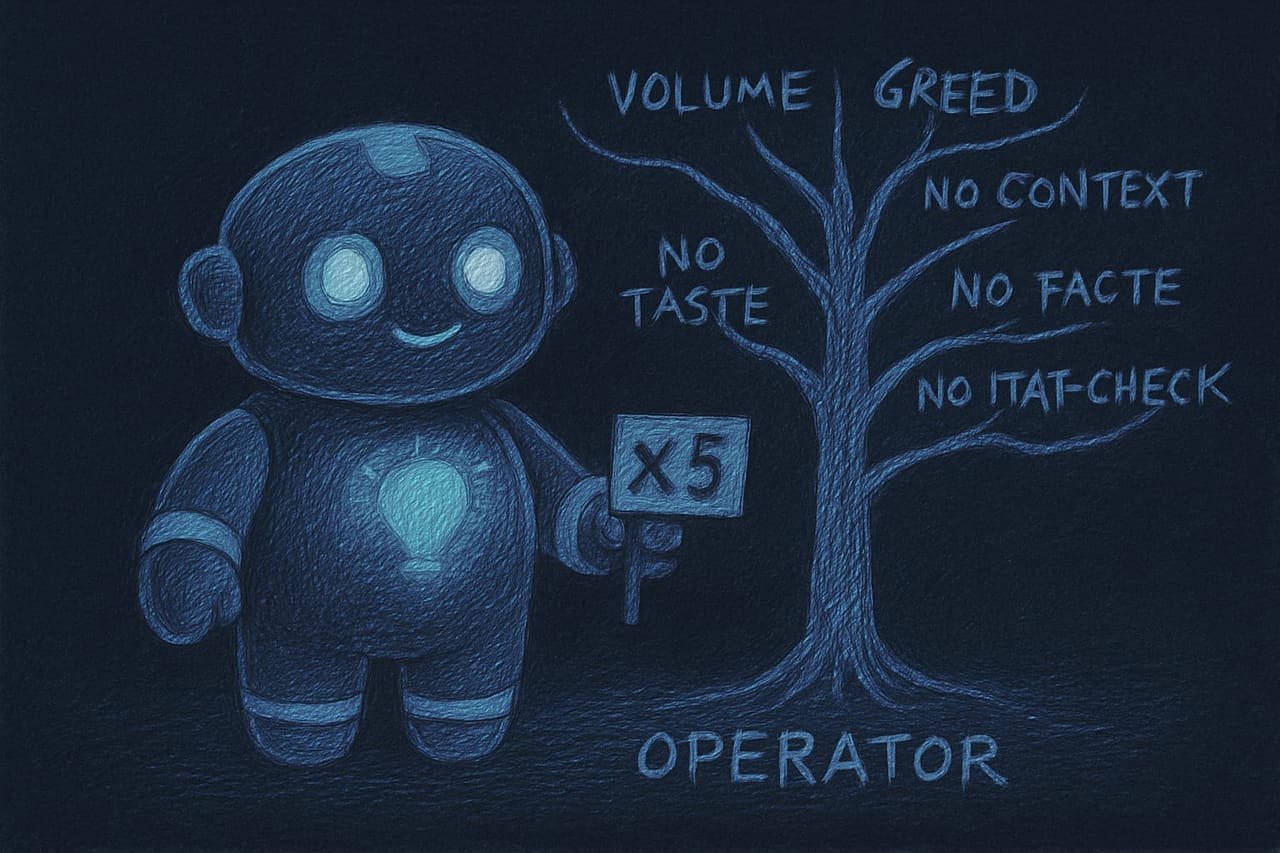
Let’s collapse the five scenarios into one thought. Greed for volume, an empty input, blindness to quality, gullibility about facts, laziness about iterations - all of these are properties not of the model, but of the human in front of it.
AI works as a competence mirror. A marketer who understands their audience gets amplification from the model: it quickly shapes thoughts that would otherwise take a day to form. A person with nothing to put in gets amplified emptiness - quickly and in any quantity. Same tool. Different reflections.
Which is why the core AI skill isn’t “knowing how to write prompts” at all. It’s the skill of knowing what you want: for whom, why, with what idea, and by what criterion you’ll tell a good result from a bad one. The prompt is merely the way you put that into words.
A quick self-diagnosis
Five questions - one per scenario. Answer honestly, it takes a minute:
- When did I last ask AI to generate more than five pieces of content at once - and how many of them did I actually edit?
- Was my last prompt longer than three sentences? Did it contain my facts, audience, and goal - or just a topic?
- Can I explain, about the last result I accepted, what exactly is good in it - in three specific sentences?
- Did I check every number and link in the last text I published - or did I take the model’s word for it?
- How many iterations did my last task get: one - or two to four?
If the answer to two or more of these is uncomfortable - congratulations, you’ve found your growth areas, and they’re specific. That’s a big step up from the abstract “I should get better at AI”.
TL;DR - если коротко
- Slop is an operator error, not a property of the model. One model, two users - two different results.
- Five scenarios: greed for volume, no context, no taste, no fact-checking, no iterations.
- AI is a competence mirror: it amplifies whatever you put into it. Put in emptiness - get emptiness back.
- The core AI skill is knowing exactly what you want to get before you write the prompt.
- The good news: all five scenarios are fixed by practice, and not one requires talent.