How to spot slop: a quality checklist for AI content
One master test, five markers - and 30 seconds to a verdict
Practical criteria for telling slop from real work in 30 seconds flat.
The master test: replaceability
If you remember one thing from this whole lesson, make it this. To spot slop, ask the text a single question: could this have been written about anything else?
Take two descriptions of a coffee shop.
The first: “Our coffee shop is a cozy atmosphere, aromatic coffee, and friendly staff. We care about every guest and use only quality ingredients. Come see for yourself!”
Now mentally swap “coffee shop” for “dental clinic”. “Our dental clinic is a cozy atmosphere and friendly staff. We care about every guest…” Does it work? Flawlessly. Swap in an auto repair shop, a coworking space, a funeral home - the text doesn’t even flinch. And that’s the verdict: a text that fits everything says nothing about anything.
The second description: “We roast in-house once a week, beans from Ethiopia and Colombia, always three lots on the shelf to choose from. We dial in the espresso every morning, and if the barista doesn’t like how the flavor opened up - they redo it on the house. Filter coffee at half price from 8 to 10 a.m., for everyone on their way to work.”
Try inserting the dental clinic here. It won’t fit. The text is nailed to one specific place: the roasting, the lots, the morning filter, the barista’s habits. It can’t be reused - and that’s exactly why you believe it.
The replaceability test takes ten seconds and requires zero expertise. It’s especially useful in three situations: when you’re choosing a contractor and reading their case studies (“boosted sales and improved loyalty” - for anyone, of anything); when you’re sizing up an “expert” by their posts; and - above all - when you’re rereading your own draft before publishing.
Next up: five markers for a finer diagnosis.
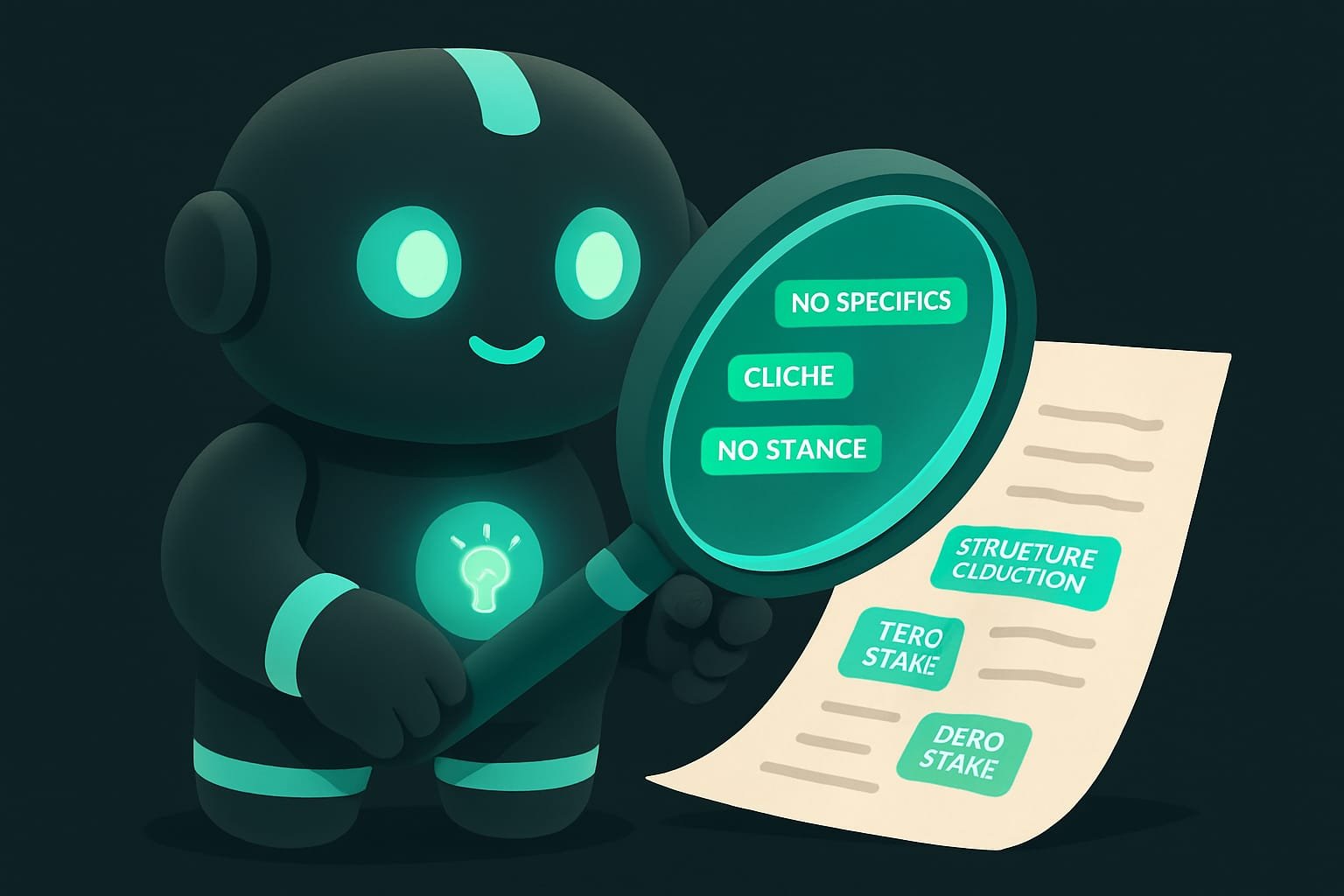
The five markers of slop
1. No specifics. No numbers, no names, no titles, no dates. “Many companies have already implemented AI and achieved significant results” - which companies? How many? What results? Compare: “Of our 12 clients who rolled out AI answers in support, nine saw first-response time drop from hours to minutes.” The second version can be checked and challenged - which is exactly what makes it alive.
2. No position. The text takes no one’s side. “Remote work has both advantages and disadvantages, and every company must find its own balance.” Thanks, big help. A living, breathing author will say: “For teams under ten people, an office is wasted money, and I’ll argue that with anyone.” You can disagree with them - but at least there’s something to respect.
3. Cliches. “In today’s fast-paced world”, “it’s no secret that”, “a real game-changer”, “level up your skills”, “the cherry on top”. Every cliche is a spot where the author could have thought and chose not to. One or two per text happens to everyone. When the entire text is assembled from them - you’re looking at slop.
4. Structure for show. Seven subheadings with three lines of filler under each. A numbered list where the items don’t differ from one another. A table where both columns say the same thing. The packaging imitates substance the way an empty TV box imitates a TV.
5. Zero stake. The author risks nothing: no reputation, no prediction, no admitted mistake. There isn’t a single spot where they could turn out to be wrong. Compare: “experts predict market growth” - versus “I’m betting half these services shut down within a year; let’s revisit this post in June.” The second author will be embarrassed if they’re wrong - and that’s exactly why people read them. A text where you can’t be wrong is a text with nothing to say.
One marker is a coincidence. Two is a reason to squint. Three or more is a diagnosis.
One topic, two texts
Here’s what it looks like with a real example. Same topic for both: “should a small business run a Telegram channel”.
- “Our bakery's channel is 8 months old: 412 subscribers, 30-40 of whom come in for bread every week” - numbers you can verify.
- “Posts with faces sell better than posts with product - 2-3x the click-throughs for us” - an observation from practice, not generic wisdom.
- “If you have less than an hour a week for the channel - don't start, a dead channel is worse than no channel” - a position you can argue with.
- “We tried posting daily and burned out in a month; two posts a week we've now sustained for half a year” - an admitted mistake, a signal of honesty.
- “In today's world, Telegram is becoming an increasingly popular platform for business” - cliche plus platitude.
- “A channel will help you raise brand awareness and build trust with your audience” - fits any business on any platform.
- “It's important to publish quality content regularly” - advice that's impossible to act on: what counts as quality? how often is regularly?
- “To sum up, a Telegram channel has its pros and cons” - a conclusion that concludes nothing, zero stake.
Notice the key thing: the left column didn’t require talent. It required raw material - real numbers and observations the bakery owner already has anyway. The slop in the right column isn’t a lack of ability. It’s a lack of invested context.
Don’t confuse slop with simplicity
An important caveat, so the checklist doesn’t turn into paranoia. Slop is not “a short text”, not “a simple text”, and not “a text without authorial metaphors”. A three-sentence post with one precise thought is not slop, even if AI helped assemble it. And a ten-screen longread with quotes from the Stoics can be premium-grade slop - if, under all the decoration, there are no specifics and no position.
Same goes for form. Lists, subheadings, tables - perfectly normal working tools, as long as there’s meaning inside them. The “structure for show” marker doesn’t trigger on the presence of structure - it triggers on the emptiness underneath it.
And one last thing: slop isn’t defined by whether AI was involved. A text a human dashed off carelessly is slop. A text assembled with AI in half an hour, but with your numbers, your position, and your edits, is normal work. The checklist tests the result, not the production process.
The self-check checklist: two minutes before publishing
The most valuable use of all this isn’t critiquing other people’s stuff - it’s checking your own. Before you hit “publish”, run the text through five questions:
- The replaceability test. Could my product be swapped for someone else’s - and the text would still read as “correct”? If yes, add the things only you have: numbers, cases, observations.
- Specifics. Are there at least three facts that can be verified: a number, a name, a date, an example?
- Position. Is there at least one claim somebody could disagree with?
- Cliches. Read the first and last paragraphs out loud. “In today’s world” and “to sum up” - cut them.
- Stake. Is there a place in the text where I’m risking something: a prediction, an opinion, an admitted mistake?
Two minutes. No editor needed, no copywriting background - just honesty with yourself. A text that passes the checklist can be written with AI from the first word to the last - and it will still be normal work, because slop is defined by quality, not by origin.
TL;DR - если коротко
- The master test: “could this have been written about anything else?” If yes - it's slop.
- Five markers: no specifics, no position, cliches, structure for show, zero stake.
- Quality AI content doesn't look like “AI content” - it looks like the work of someone who knows their stuff.
- The checklist works in reverse too: run your own work through it before publishing. Two minutes.