Deep Internet Research: How AI Actually Finds Facts
When AI stops guessing from memory and goes off to read the primary sources
Deep research: how to make AI search dozens of sources, read them in full, fact-check, and come back with a report full of links and dates.
What deep research actually means, in plain English
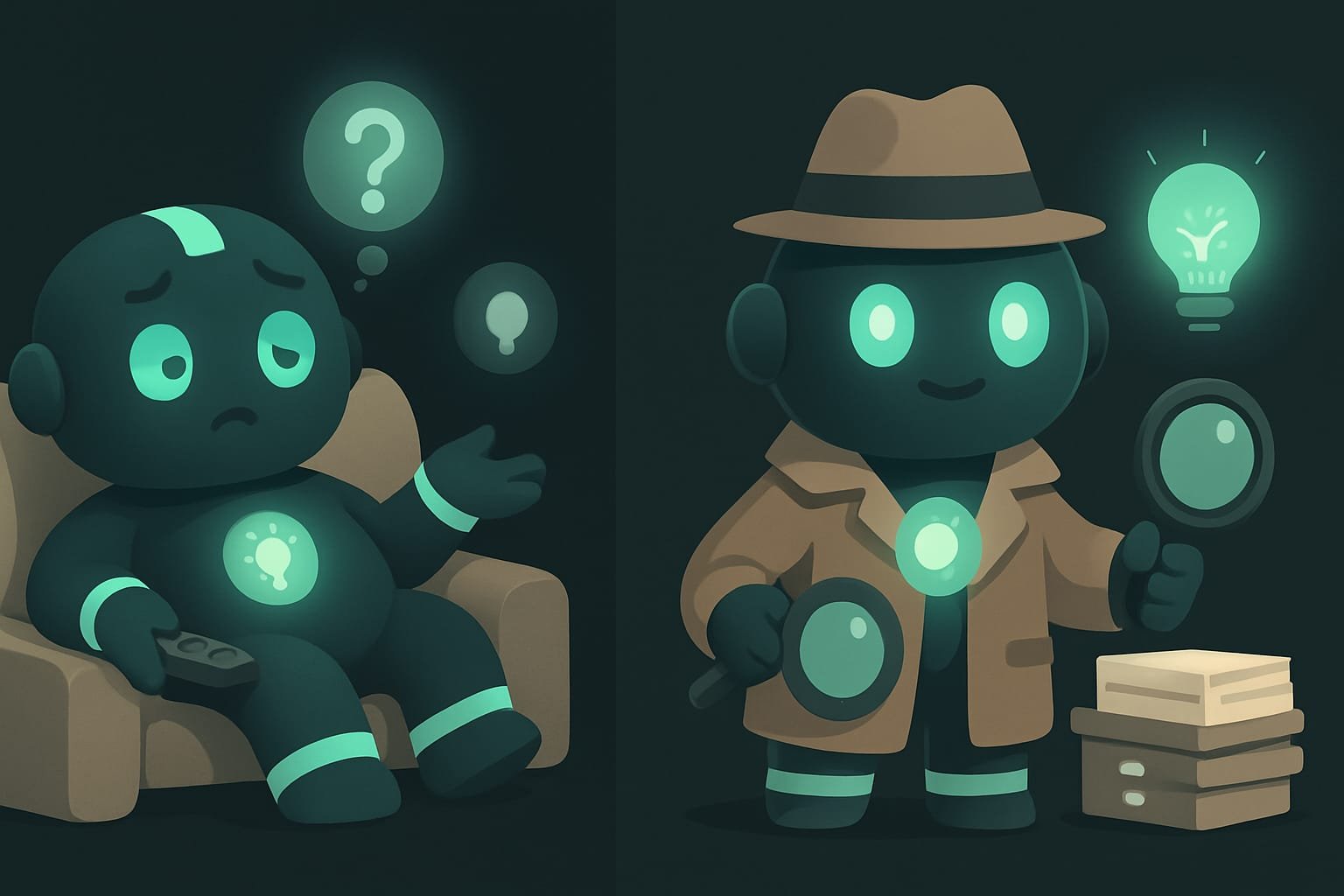
Ask two friends: “which laptop should I get for video editing in 2026?”
The first one answers without getting off the couch: “Eh, grab a MacBook, probably fine.” He’s not lying out of malice. He’s just talking from memory, from something he half-heard once. Maybe the info is two years old. Or maybe he just made it up on the spot.
The second one gets up. Opens a dozen reviews, reads the latest benchmarks, compares prices across three stores, jots down the pros and cons. And hands you a sheet: “Here are three options, here’s why, here are the links, check for yourself.”
Feel the difference? The first guy is regular AI running on memory. The second is deep research Deep research is a mode where AI doesn’t answer off the top of its head but actually searches the internet across many sources, reads them in full, and assembles a report with links. . And, no exaggeration, this is one of a vibecoder’s biggest superpowers.
Why a vibecoder needs deep research
You’re a vibecoder. All day you make decisions: which service to plug in, which library is still alive and which one’s been a corpse for years, how much hosting costs, what’s even in fashion right now. And this is exactly where AI’s memory will gleefully throw you under the bus.
- Tech changes every month — whatever the AI “knew” may well have gone stale.
- Prices, plans, and terms are always “as of today.” Taking them from memory is like checking the train schedule against last year’s calendar.
- Before picking anything, a smart person compares the options — deep research does that for you.
- Links give you the right not to take the AI’s word for it and to verify everything yourself.
“The AI said it, I did it, turned out to be garbage” versus “The AI brought me three verified options with links.” That right there is the chasm between guessing and researching. Let’s break down how it works under the hood.
How deep research works: five steps
Deep research isn’t “typed one phrase into search.” It’s a whole ritual. Here’s what it looks like with a proper research skill.
Step 1. Figure out what you actually need
A good AI doesn’t go charging off to search from the doorway. First it asks a couple of clarifying questions: is this for learning, for making a decision, or to write something? What’s the budget, the region, the depth? Because “which car should I buy” with no budget and no city is a question about nothing. And the answer will be exactly as useless.
Step 2. Split the question into 3-5 sub-questions
A big question gets broken into small ones. You ask “how’s nuclear fusion doing these days?” — and inside, the AI breaks it into pieces: what the main projects are right now, what the real results are, what the problems are, who the leaders are, how much money is being poured in. And each sub-question gets searched separately.
Step 3. Search across a pile of sources, not just one
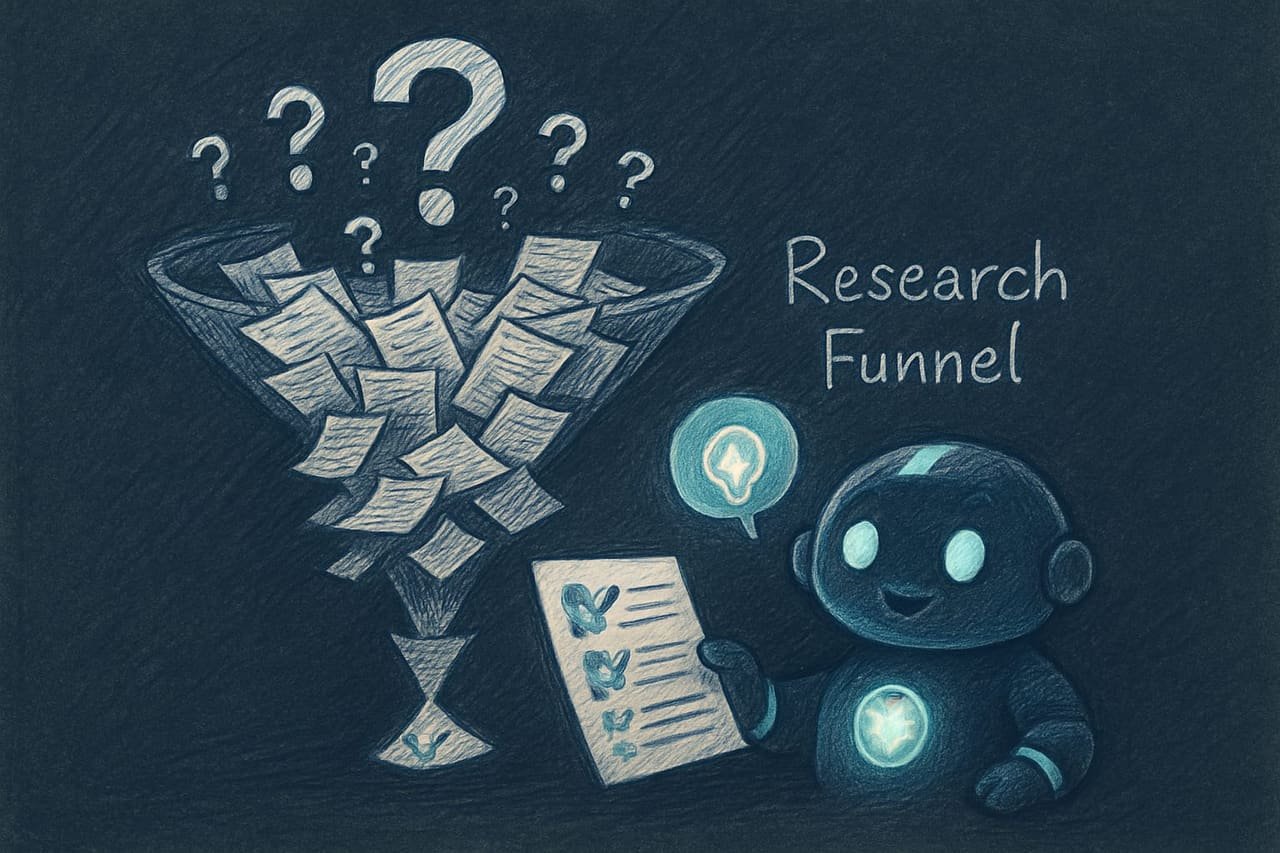
For each sub-question, several queries with different wordings. The goal is to gather 15-30 different sources. And not just whatever comes up in a row: scientific papers and official sites rank higher than random blogs, and blogs rank higher than forums and comments under videos.
Step 4. Read the key sources in full
This is what separates the pro from the slacker. Weak research only reads the headlines and snippets (short excerpts from search results). Good research opens the 3-5 most important pages and reads them in full. Because headlines often lie for the click, and the truth is hiding in the third paragraph.
Step 5. Assemble a report with links
At the end, it’s not “here are my thoughts” but a proper report: a short summary up top, the topics neatly laid out, a link for every fact, a source list, and an honest note wherever the data ran short.
The rules that keep research honest
The deep research skill rests on strict rules. Remove them and the AI immediately slides back into its cozy “I think I heard somewhere.”
- Every fact has a link — no link, no fact.
- If something comes from only one source, it’s honestly flagged as “not verified.”
- Freshness is prized: a preference for sources from the last year.
- No data found? That’s exactly what it says: “insufficient information,” instead of making things up on the fly.
- Bare claims with no sources — “well, everybody knows that.”
- One blog inflated into the ultimate truth.
- Info from two years ago passed off as fresh with no date at all.
- Gaps in the data papered over with invention — just so the answer looks pretty.
When one query is enough, and when you need the full breakdown
Not every question deserves a heavy investigation. Sometimes you need a quick fact, sometimes a full report. The principle is the same: take the lightest path that gets the job done.
- One or two quick search queries when you just need a simple fresh fact.
- Good for “how much does it cost,” “is this library still alive,” “did a new version come out.”
- Cheap and done in a couple of minutes.
- A full multi-source breakdown with dozens of links.
- Needed when you’re making an important decision or comparing options.
- More expensive and slower, but you get a report you can actually trust.
A real-life example: choosing a payments service
You’re building a site and you think: “let me plug in some service for accepting payments.” You ask a regular AI — it recommends the first thing it remembers. You wire it up, kill an evening, and then it turns out: the service doesn’t work in your country, the rates have already gone up, and everyone moved to a different one ages ago. Sound familiar?
Now watch how the same thing goes for a vibecoder who knows how to do deep research.
Do deep research: which online payments service is best to connect to a simple personal website for an individual in my region in 2026.
Do it like this:
- First, ask me 2 clarifying questions (region and type of payments).
- Split the task into sub-questions: country availability, fees, ease of setup, reviews from the last year.
- For each sub-question, find several sources — at least fifteen in total.
- Read the most important pages in full, not just the headlines.
- In the answer, give every fact a link and a date. If there’s only one source, flag it as not verified.
- Split the report into: verified facts, my data, your guesses, and a final recommendation.
- At the end, give a source list and honestly say where the data ran short.
Monitoring: when the same question keeps coming back
A small but mighty trick. Catch yourself googling the same thing over and over — exchange rate, competitor prices, news on a topic? That’s a signal. Instead of manually launching research every single time, ask the AI to set up monitoring: a recurring check that does the work for you on a schedule. Set it up once, and from then on it runs itself.
Common mistakes when working with deep research
- Trusting an answer with no links. A pretty number with no source may well be invented. No link, no fact.
- Not asking for the date. For prices, news, and “what’s the situation right now,” an answer with no date is useless. Always ask “as of what date is this current.”
- Drawing a conclusion from a single source. One blog is an opinion, not the truth. You need at least a second source to verify.
- Launching heavy research where one query would have done. Cracking a nut with a sledgehammer — slow, expensive, and completely pointless.
- Swallowing the facts-and-guesses mush. Make the AI separate them: where the verified fact is, and where it’s making things up.
- Googling the same thing by hand a hundred times. If the question keeps repeating, set up monitoring and forget about it.
TL;DR - если коротко
- A regular AI answer is memory from last year. Deep research is when it actually goes online and reads the fresh stuff right now.
- Proper deep research splits your question into 3-5 sub-questions, googles each one, and reads the sources in full instead of just skimming headlines.
- The golden rule: every fact gets a link. A single source is a “not verified” flag, not the truth.
- Always demand a date. For prices, news, and “what’s the situation right now,” an answer with no date goes straight in the trash.
- AI has to neatly separate the fact, your data, the guess, and the recommendation instead of dumping it all into one mush.
- Running the same query by hand over and over? Ask it to set up monitoring and let it check for you on a schedule.