AI Agent vs. Chatbot: the difference, in plain words
One just gives you advice. The other rolls up its sleeves and does it for you.
How an AI agent differs from a chatbot: a chatbot talks, an agent acts with its own hands - it creates files, runs code, fixes errors. Get this, and vibecoding finally clicks.
Chatbot vs. AI agent: the difference, dead simple
You’re craving pizza. From here, two roads.
Road one. You’ve got a brilliant friend who cooks. You call, and he walks you through it step by step: “Knead the dough, preheat the oven to 250, throw on the mozzarella, easy on the salt…” He knows literally everything about pizza. One catch. You’re still the one making the pizza. With your hands. In your kitchen. On your hard-earned day off.
Road two. A chef shows up at your door. You toss out, “I want pepperoni.” And he heads to the kitchen, kneads the dough himself, slides it in the oven himself, tastes it himself, adjusts the salt himself - and brings you a finished pizza on a plate. Your only job: eat.
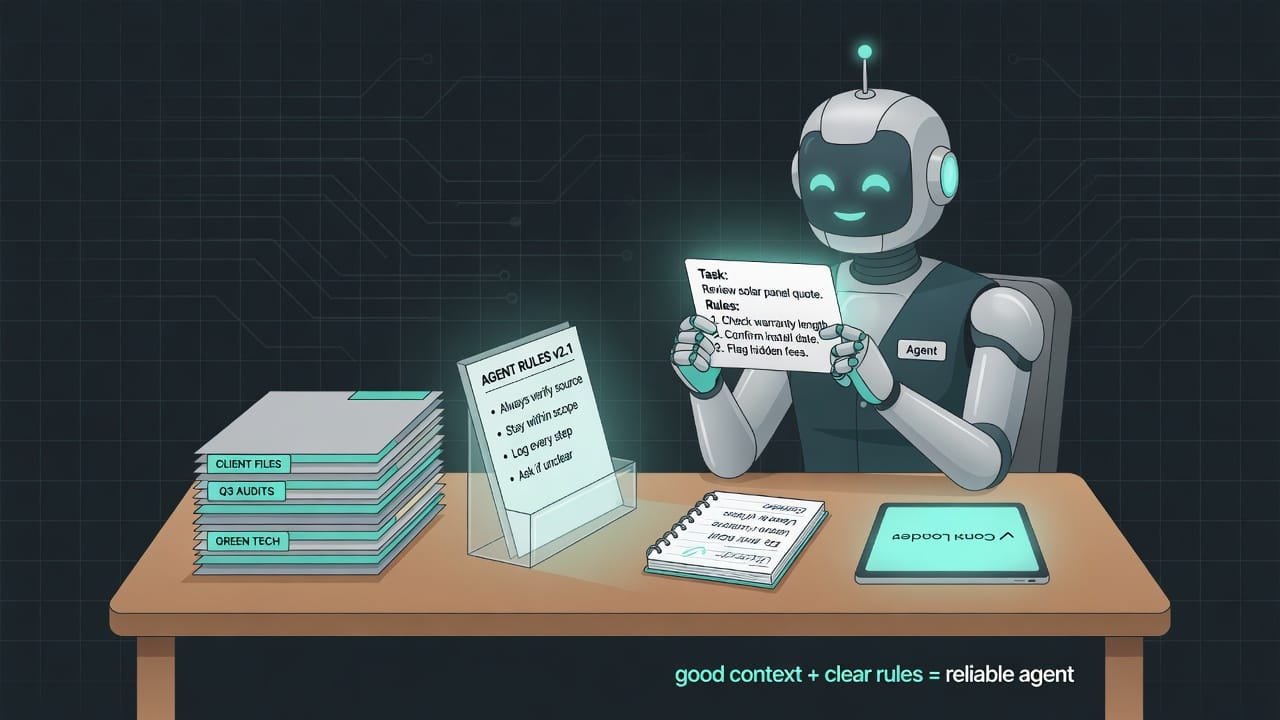
The brilliant friend on the phone is a chatbot A chatbot is a program that holds a conversation with you: you type a question, it types an answer. It never steps outside the chat window and does nothing on your behalf - it only talks. . The chef in your kitchen is an AI agent An AI agent is an AI that has tools and permission to use them: create files, run programs, search the web, check the result. It doesn’t give advice - it carries out the task itself, step by step. . That’s the whole secret.
Why this distinction matters to a vibecoder
You’re a vibecoder. And I’ll bet your first date with AI was with a chatbot: you asked something, you got an answer in text. Useful? Sure. Vibecoding? Not yet.
Vibecoding starts where the AI stops talking and starts building your project with its own hands. Miss this distinction, and here are the holes you can fall into:
- you wrangle some advice out of the AI - and then, sweating through your shirt, redo all of it by hand;
- you’re baffled why “plain old ChatGPT in the browser” won’t just go build you a website;
- you don’t get why an agent needs access to your files, terminal, and the internet in the first place.
Once the distinction clicks, you’ll instantly understand what’s actually going on when you sit there watching the agent create file after file and write code. No magic. Just a chef in your kitchen.
How an AI agent works: hands and a working loop
The agent’s tools: its hands inside your project
A chatbot can do exactly one thing - write text back. An agent can do the same, plus use tools. A typical set of “hands” looks like this:
- create or change a file - the agent writes code straight into your project;
- run a command - for example, spin up the site and check whether it’s alive;
- read the project files - to understand what’s already been built;
- search the web - when it’s missing fresh facts.
It’s the tools that turn “tell me how to make a website” into “make me a website.” See the difference?
The agent’s loop: think, do, check, fix
A chef doesn’t make a pizza in one go. He works in steps: mix the dough, look at what came out, roll it, taste it, adjust the salt. An agent runs the exact same loop:
- think - what needs doing right now;
- take a step - for example, create a file;
- look at the result - run it, check whether there’s an error;
- draw a conclusion - all good, or does it need a fix;
- and back to step 1 - until the task is done.
This “think, do, check” loop is where the magic happens: the agent catches and fixes its own slip-ups right in front of you. By itself. Without you.

One model - two different behaviors
Here’s the part that blows beginners’ minds. Inside a chatbot and an agent there can be the very same AI - say, Claude. The difference isn’t in the “brain.” The difference is whether it was given hands and the right to use them.
A bare AI in a browser window is a chatbot. The same AI, hooked up to files, a terminal, and the internet, is now an agent. Same brain. But the capabilities are night and day.
Side by side: what a chatbot can do vs. an agent
- Creates and changes files in your project by itself.
- Runs the code itself and sees how it turned out.
- Fixes its own errors in a loop - no scrambling on your end.
- Carries the task through to a result, not just to advice.
- Only writes text back - the rest is on you to grind through.
- Doesn’t see your project and changes nothing in it.
- Made a mistake? You go and redo it yourself.
- Brilliant at explaining and advising - but it won’t do it by hand.
A real-world example: a one-page personal site, two ways
Say you need a simple personal landing page. Compare the two roads.
With a chatbot you type: “how do I make a personal website?” Back comes a wall of text with code. And the rest is all on you: you create the file yourself, paste in the code yourself, open it, see an error, copy it back into the chat, ask “why doesn’t it work?”, and patch it by hand again. Round and round it goes, until your tea goes cold. Exhilarating, right?
With an agent you just say what you want - and watch it sort everything out on its own. Want to try it? Drop a prompt like this into any tool with an agent:
Make a simple one-page personal site about me. Work on your own, step by step:
- First, ask me for my name, what I do, and which contact to show.
- Create the project files yourself.
- Launch the page and confirm it opens without errors.
- If something breaks - fix it yourself and check again.
- At the end, briefly tell me what you made and how to open it.
Common beginner mistakes when working with AI
- Confusing ChatGPT in the browser with an agent. A plain chat window usually just talks. For the AI to actually do things, you need a tool with an agent.
- Expecting a chatbot to take action. It’ll write perfect code, but it won’t create the file for you. And don’t expect it to - that’s not its job. Just like you don’t expect the menu at a restaurant to feed you.
- Asking for advice when you need the work done. Write “how do I…” and you’ll get instructions. Want results? Write “do…”.
- Thinking the agent is “smarter.” Inside, it can be the very same model. It’s not about brains, it’s about hands: tools or no tools.
- Fearing the agent will “do it all wrong on its own.” An agent works in a loop and shows you every step. You can stop it and course-correct at any moment.
TL;DR - если коротко
- A chatbot is a conversation partner. It talks; you’re the one who actually goes and does the work.
- An AI agent is a doer. It creates the files, runs the code, and checks how it turned out - all by itself.
- It’s not about who’s smarter, it’s about who can take action: read, write, run, fix.
- An agent runs a loop: think, take a step, look at the result, keep going.
- Both can have the exact same model inside. The question is whether you gave it hands.
- Vibecoding is exactly this: working with an agent. You say what, the agent figures out how.