A Council of Four AIs: How to Make a Hard Decision
One advisor will just nod along. Four will actually make you think
The council technique: how to make the AI argue with itself across four roles so you make a hard call deliberately, instead of grabbing the first option that comes along.
What a council of four AIs is, in plain words
Picture this: you’re deciding where to go on vacation — the mountains or the beach. You ask one friend. He says cheerfully, “the beach!” — so you go. And it turns out to be the rainy season, prices are triple, and honestly, you can’t stand the heat.
Your friend isn’t the problem. The approach is. You asked one person. You should have gathered a group. One would have pushed back: “are you sure you even want to go?” Another: “grab the cheapest option and don’t overthink it.” A third: “and if the flight gets cancelled — then what?”
That’s exactly what a council A council is a technique where you get not one opinion from the AI, but four different ones, each with its own role and its own angle on the question. They argue, and you choose. is — when the AI answers not in one voice, but in four, and each one looks at your question from its own corner.
Why a vibecoder needs a council of several AIs
You’re writing code with AI — and sooner or later you’ll hit a question that has no obvious answer:
- build the site on a ready-made site builder, or write it from scratch?
- ship the rough version now, or polish it for another week?
- add a big feature, or actually strip everything down?
Ask the AI “what’s better?” and it’ll usually hand you one tidy answer, quietly leaning into whatever you’re already inclined toward. That’s called anchoring Anchoring is when the AI (like a human) latches onto whatever has already been said in the conversation and tailors its answer to match your expectation, instead of giving an honest assessment. . And it’s a trap.
The council breaks it. Instead of “yeah, let’s do that,” you get four positions that pull in different directions. And when there’s a live argument right in front of you, you finally decide for yourself — instead of drifting along with the first piece of advice.
How Claude assembles a council: four voices at the table
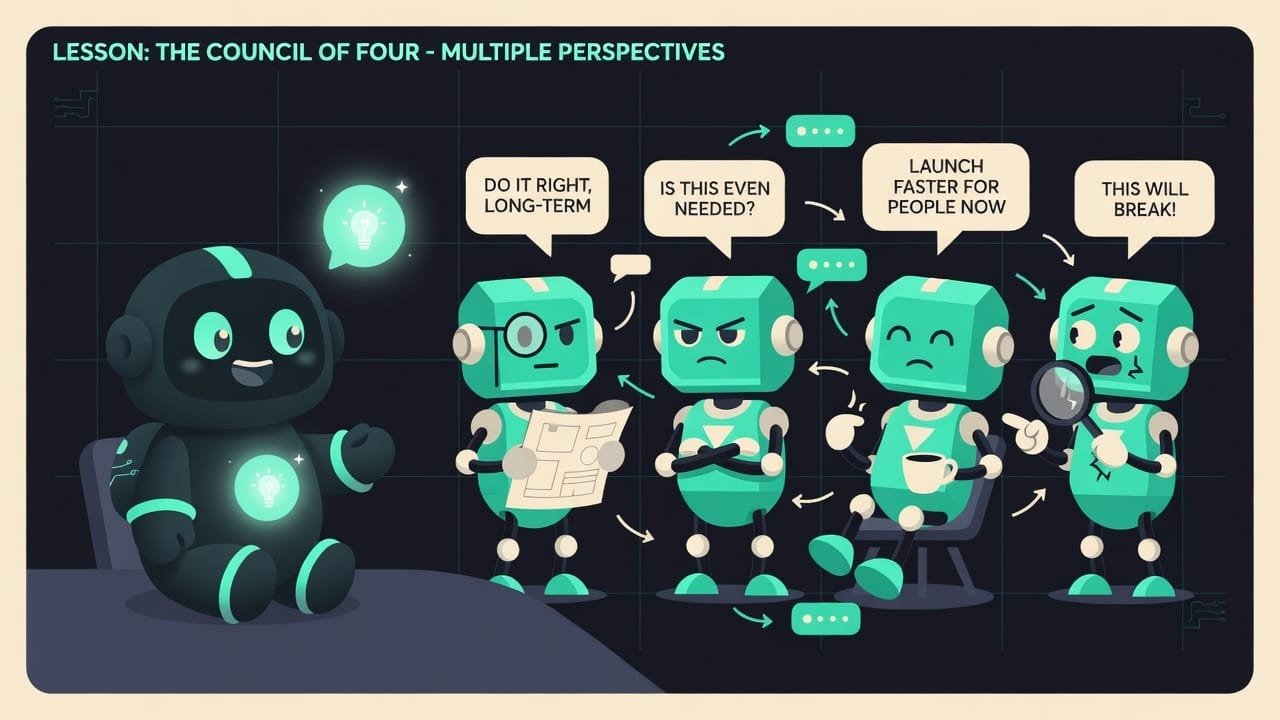
The council technique in ECC sits four advisors down at the table for a single question. One is Claude itself, the one you’re talking to. The other three are fresh helpers: they’re given only your question, without all of your chat history. They’ve got nothing to nod along to — they simply don’t know you.
The four roles of an AI council: who’s who
| Voice | What it watches for |
|---|---|
| The Architect | how to do it right, reliably, and for the long haul |
| The Skeptic | whether you even need this, whether there’s a simpler way |
| The Pragmatist | how to launch faster, what matters to people right now |
| The Critic | what will break, where the catch is, what’s at risk |
Why three of the voices have to be fresh
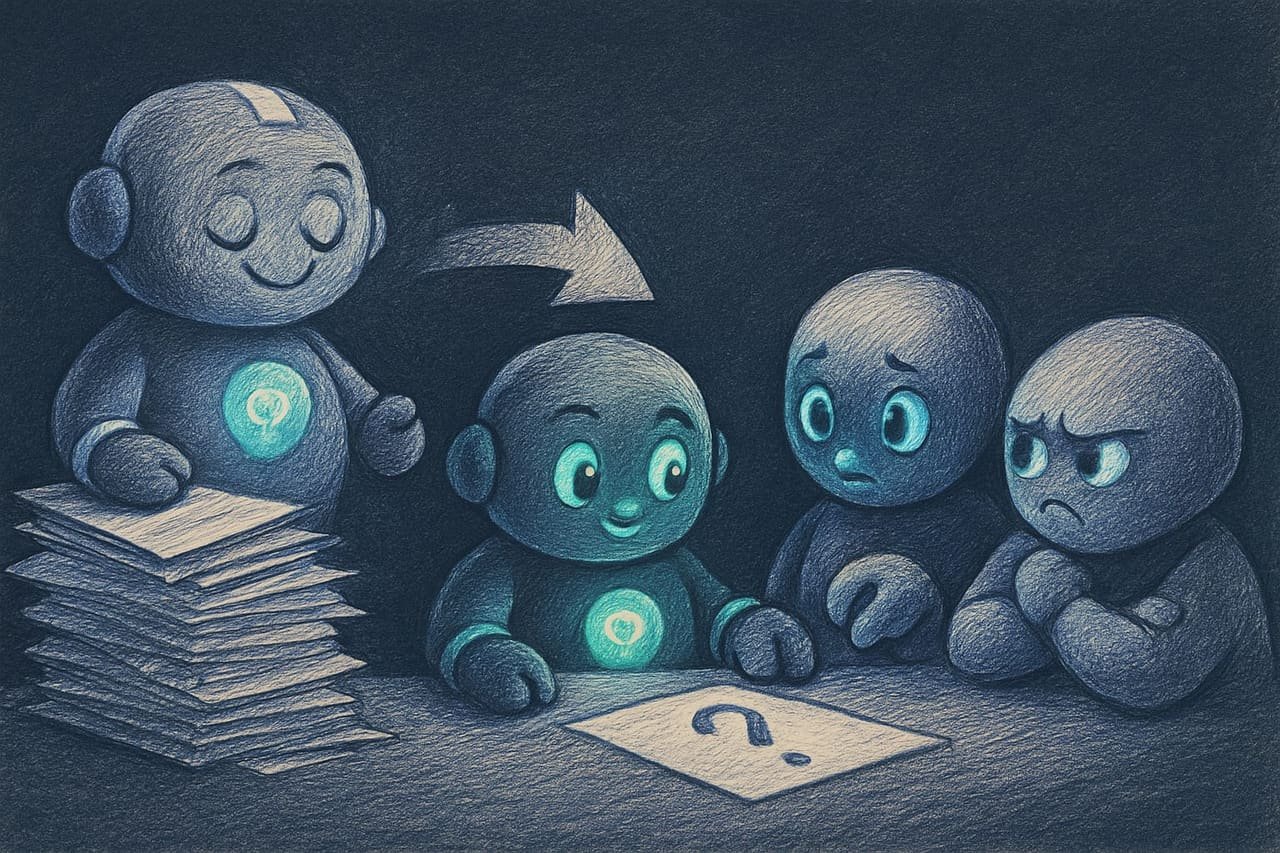
This is where the real secret of the technique hides. If all four saw your entire conversation, they’d cheerfully pick up your mood and the direction you set. And there’d be no argument. Just a chorus of yes-men. So three of the voices are given only the question and a small bit of needed context. No chat history. That’s the vaccine against nodding along.
What you get at the end
Once everyone has spoken, Claude pulls the opinions together and shows you a compact summary: where everyone agrees, where the argument is sharpest, and what it recommends itself. Honestly, without sweeping the disagreements under the rug.
When to call the council, and when not to
The technique is powerful, but not free: four voices means four rounds of “thinking” — more time and more tokens. Call it in where it’ll actually pay off.
- The decision has several live options and no clear winner.
- You need to see the pros and cons, not just get an answer.
- It’s a “launch or wait” kind of call, where a mistake is costly.
- You feel the AI is nodding along and you want an honest argument.
- It’s a plain fact (“what’s 2+2”) — just ask.
- It’s an execution task (“make a button”) — just do it.
- You need to find a bug in the code — that’s a different job, not a council.
- You need to break a feature into steps — that’s a plan, not a fork in the road.
Example: ship the site now or keep polishing
You’ve just finished your first site — a landing page for your mom’s coffee shop. It works, but it isn’t buttoned up: a couple of slightly off margins, no animations, one block shifts a bit on mobile. And tomorrow your mom has an important meeting with the landlord, and she’d love to show off the site.
The question: ship it now, or sit on it for two more days and polish it to a shine?
Ask once, and the AI will most likely gently back whatever you’re already leaning toward. Now watch how the council breaks it down.
Assemble a council of four voices on my decision.
Question: ship the coffee shop landing page now, or spend two more days polishing it?
Context: the site works, but there are minor issues with the margins, no animations, and one block shifts slightly on mobile. Tomorrow my mom has an important meeting where the site would come in handy.
Give four separate opinions, each in its own role:
- Architect: how to do it right and reliably
- Skeptic: whether polishing before the meeting is even necessary
- Pragmatist: how to get the most value as fast as possible
- Critic: what could go wrong in each option
At the end, pull together a short summary: where everyone agrees, where the strongest disagreement is, and what you recommend. Leave the final decision to me.
And here’s what you get instead of a lonely “eh, just ship it”:
- The Architect: at least fix the shifting block on mobile — half your visitors will land on it.
- The Skeptic: will the landlord even look at the site? Maybe one clean home page is enough?
- The Pragmatist: ship now, just fix the mobile block in half an hour, leave the rest for later.
- The Critic: showing something rough on mobile is worse than going without animations — it’ll spoil the first impression far more.
Common mistakes when working with a council
- Calling the council for trivia. If the answer is obvious, it’s a waste of time and tokens. The council is for genuine forks in the road only.
- Feeding the whole chat to every voice. Then they all start nodding along in chorus, and the whole point evaporates. Fresh voices get only the question.
- Expecting unanimity. The council’s value is precisely in the disagreement. Everyone cheerfully on board? Maybe the question wasn’t really up for debate.
- Hiding the argument in the summary. A good summary brings the strongest objection into the light, instead of sweeping it under the rug.
- Offloading the decision onto the AI. The council shows you the options, but you’re the one who presses the “let’s do this” button.
- Confusing the council with other techniques. Finding a bug, writing code, drawing up a plan — that’s not a council, those are different tools.
TL;DR - если коротко
- A council is four different AI opinions instead of one, and they argue with each other.
- Four roles: the Architect (how to do it right), the Skeptic (do we even need this), the Pragmatist (how to do it faster), and the Critic (what will break).
- Call it in for hard decisions with a real fork in the road, not for “write some code” or “find a bug.”
- The trick is that three of the voices are fresh — they haven’t seen your chat, so they won’t just nod along.
- What you get isn’t one answer, it’s a map of the disagreements. You decide, with a clear head.
- The council isn’t free: four voices means four rounds of “thinking.” Save it for genuine forks in the road.